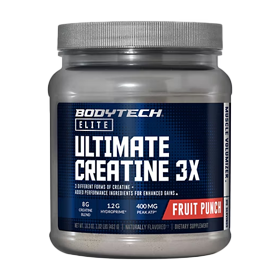
Creatine has long been a staple in sports nutrition. While PEAK ATP® represents a newer, clinically studied advancement in performance energy. When combined, these two ingredients support complementary energy pathways that align with how the body produces power, sustains output, and responds to intense training.
Rather than overlapping in function, creatine and PEAK ATP® work through two different distinct mechanisms. This creates a performance strategy that supports both intracellular ATP recycling and extracellular ATP availability, two critical components of high-intensity exercise.1
Why ATP Is Central to Performance
Adenosine 5’-Triphosphate (ATP) Disodium is the primary energy molecule used by every cell in the body. Every muscular contraction, sprint, jump, and lift depends on the availability and turnover of ATP.
During intense exercise:
- ATP is rapidly broken down into ADP1
- ADP must be efficiently recycled back into ATP1
- This cycle repeats thousands of times per day1
Despite the body maintaining only a small total ATP pool, it continuously regenerates ATP at extraordinary rates to meet performance demands.
Both creatine and PEAK ATP® support this cycle, but through very different biological pathways.
Creatine: Supporting ATP Resynthesis Inside Muscle
Creatine supplementation increases intramuscular creatine and phosphocreatine stores. Phosphocreatine plays a direct role in rapidly regenerating ATP during short-duration, high-intensity exercise.2
Creatine is widely used in:
- Resistance training
- Sprinting and power sports
- Explosive athletic performance
- High-intensity training
Its primary contribution is accelerating ATP resynthesis inside the muscle, supporting repeated efforts during short, intense bouts of activity.
Creatine supplementation strategies often include:
- A multi-day loading phase2
- Ongoing daily maintenance intake2
- Long-term consistent use to maintain elevated intramuscular stores2
PEAK ATP®: Supporting ATP Availability and Muscle Activation
PEAK ATP® is a patented and clinically studied form of ATP designed for dietary supplementation. Unlike creatine, which works primarily inside muscle cells, PEAK ATP® supports extracellular ATP signaling, which plays a role in:
- Mitigating exercise-induced declines in ATP1
- Supporting blood flow during exercise1
- Increasing muscle excitability1
- Supporting force output and training volume1
PEAK ATP® has also been shown to:
- Work acutely with a single dose5
- Support post-exercise ATP levels4
- Enhance muscle contractility4
- Support blood flow through nitric oxide signaling pathways3
This positions PEAK ATP® as a rapid-acting performance ingredient.
Why Creatine and PEAK ATP® Work Better Together
Creatine and PEAK ATP® do not compete. They operate through different mechanisms and support different aspects of ATP metabolism.
1. Dual-Pathway Energy Support
- Creatine supports ATP regeneration inside muscle
- PEAK ATP® supports ATP availability and signaling outside muscle
This supports ATP function inside the muscle and throughout the body during performance.
2. Support for Strength, Power, and Repeated Effort
Together, creatine and PEAK ATP® align with training programs built around:
- Maximal strength output2
- Explosive power2
- Repeated sets and high training volume2
- High-intensity resistance exercise2
This pairing is commonly used in advanced pre-workout formulas, strength powders, and performance stacks.
3. Blood Flow and Nutrient Delivery
Extracellular ATP plays a role in stimulating nitric oxide signaling, which supports blood flow during exercise. Increased circulation supports:
- Oxygen delivery3
- Nutrient transport3
- Metabolic waste removal3
This complements creatine’s role in intracellular energy recycling and further reinforces the performance synergy between both ingredients.
4. Immediate and Long-Term Performance Strategy
- Creatine supports long-term intramuscular ATP regeneration when used consistently
- PEAK ATP® supports immediate training output with acute effectiveness
Together, they create a strategy that supports both today’s workout and long-term performance adaptation.
Performance Outcomes Linked to the Creatine + PEAK ATP® Strategy
Research highlighted in the PEAK ATP® + Creatine position paper explores associations with:
- Increased strength and power output
- Increased training volume
- Increased muscle contractility
- Increased blood flow during exercise
- Increased post-exercise ATP levels
- Increased recovery efficiency
These outcomes reinforce why this combination continues to gain traction in high-performance formulations.
Supplementation Strategy Overview
Typical usage strategies include:
- Creatine: Daily intake for consistent intramuscular saturation
- PEAK ATP®: Consumed pre-workout to support acute training output
When used together, PEAK ATP® is commonly stacked with one of the daily creatine doses to maximize training-day performance.
OptiCreatine™: A Modern Approach to Creatine Delivery
From a formulation standpoint, how creatine dissolves and delivers matters just as much as its performance role. OptiCreatine™ was developed to improve that experience from mix to consumption.
Unlike traditional creatine powders that can appear gritty or leave residue, OptiCreatine™ is engineered for rapid, complete dissolution, forming a clear, sediment-free solution in seconds. This enhanced solubility supports greater formulation flexibility across powders, tablets, gummies, chewables, effervescent pellets and more to improve overall consumer experience.
For brands focused on clean formulation, mixability, and consistent product quality, OptiCreatine™ offers a refined, performance-ready creatine solution backed by TSI Group’s ingredient science standards.
Download the Full PEAK ATP® + Creatine Position Paper
For a deeper scientific breakdown, including:
- Detailed mechanisms of action
- Supporting research
- Figures and pathways
- Performance outcomes
- Supplementation protocols
Download the full PEAK ATP® + Creatine Position Paper to explore the complete science behind this advanced performance strategy.
References:
- Jäger R, Purpura M, Rathmacher JA, Fuller Jr JC, Pitchford LM, Rossi FE, Kerksick CM: Health and ergogenic potential of oral adenosine-5 ‘ -triphosphate (ATP) supplementation. J Funct Foods 2021, 78:104357. doi: 10.1016/j.jff.2021.104357.
- Kreider RB, Kalman DS, Antonio J, Ziegenfuss TN, Wildman R, Collins R, Candow DG, Kleiner SM, Almada AL, Lopez HL: International Society of Sports Nutrition position stand: safety and efficacy of creatine supplementation in exercise, sport, and medicine. J Int Soc Sports Nutr. 2017, 14:18. doi: 10.1186/s12970-017-0173-z. https://pubmed.ncbi.nlm.nih.gov/28615996/
- Jäger R, Roberts MD, Lowery RP, Joy JM, Cruthirds CL, Lockwood CM, Rathmacher JA, Purpura M, Wilson JM: Oral adenosine-5’-triphosphate (ATP) administration increases blood flow following exercise in animals and humans. J Int Soc Sports Nutr. 2014, 11:28. doi: 10.1186/1550-2783-11-28. https://pubmed.ncbi.nlm.nih.gov/25006331/
- Purpura M, Rathmacher JA, Sharp MH, Lowery RP, Shields KA, Patl JM, Wilson JM, Jäger R: Oral Adenosine-5’-Triphosphate (ATP) Administration Increases Post-Exercise ATP Levels, Muscle Excitability and Athletic Performance Following a Repeated Sprint Bout. J Am Coll Nutr. 2017, 36(3):177-183. doi: 10.1080/07315724.2016.1246989. https://pubmed.ncbi.nlm.nih.gov/28080323/
- M.C. Freitas, J.M. Cholewa, J. Gerosa-Neto, D.C. Gonçalves, E.C. Caperuto, F.S. Lira, F.E. Rossi: Single dose of oral ATP supplementation improves performance and physiological response during lower body resistance exercise in recreational resistance trained males. J Strength Cond Res 2019, 33(12):3345-3352. doi: 10.1519/JSC.0000000000002198. https://pubmed.ncbi.nlm.nih.gov/29045315/